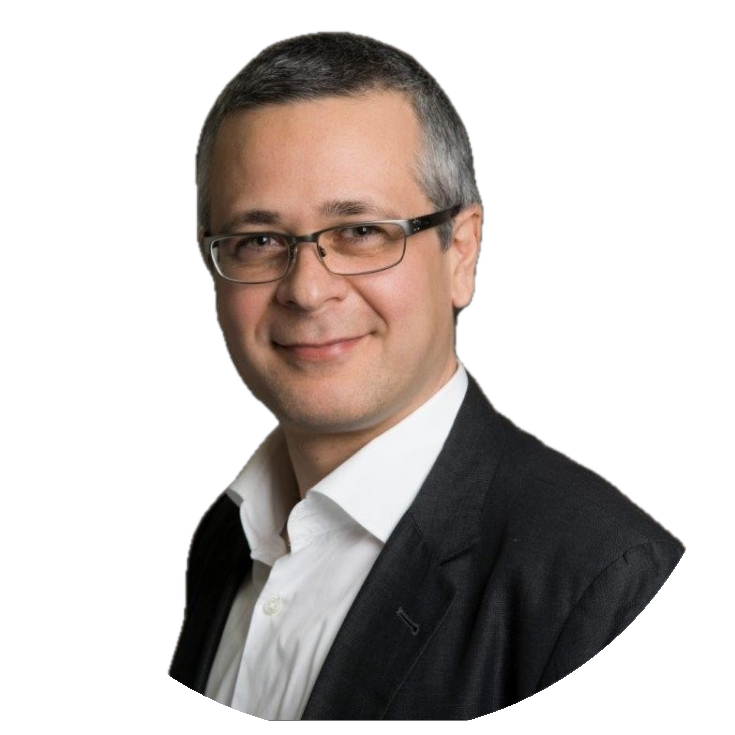
Welcome to Gabriel Vasile's Home Page
Area of Expertise
- Data Processing & Analysis
- Machine Learning, AI
- Speckle, Radar
- Remote Sensing, Earth Observation
- Polarimetry, Interferometry, Tomography
- Acoustics and Vibration
Contact Information
GIPSA-lab, CNRS / Grenoble INP
11 rue des Mathématiques
Domaine universitaire – BP 46
F-38402 Grenoble Cedex, France
gabriel.vasile AT grenoble-inp.fr
Hebbian Hub
Advocating for free software, independent benchmarks and innovative applications in the fields of Machine Learning & Artificial Intelligence (ML & AI). Visit the Hebbian Hub.
Gabriel's Bio – Research Scientist
Gabriel Vasile received the M.Eng. degree in electrical engineering and computer science and the M.S. degree in image, shapes, and artificial intelligence from POLITEHNICA University, Bucharest, Romania, in 2003 and 2004, and the Ph.D. degree in signal and image processing from Savoie University, Annecy, France, in 2007.
Professional Experience


Education

PhD Supervision
Teaching (55h eq. TD / year)

Grenoble INP – Phelma & IUT 1 Grenoble:
- Digital Signal Processing (20h)
- Metrology and Sensors (5h)
- Numerical Methods (30h)
Fellowships & Awards



International Scientific Exchange
- Annual visits – Politehnica Univ. of Bucharest (2010–2023) · ETASM school (2022–2025)
- U. of Alaska Fairbanks (2023) · Chinese Academy of Sciences (2017) · French Embassy Beijing & Shanghai (2016)
- Crna Gora U. (2011, 2012, 2015) · Arizona State U. (2014) · Villanova U. (2011, 2013) · Schlumberger (2013) · U. of Rijeka (2013)
Academic Collaborations
- S. Vitale (Parthenope U. Naples) & G. Fornaro (IREA-CNR) – SAR satellite imagery
- S. Ciochina & A. Anghel (UPB) – radar satellite imagery, RRSM
- E. Trouvé (LISTIC-USMB) & J.-M. Nicolas (LTCI-Télécom Paris) – glacier monitoring
Languages
French (fluent) · English (fluent) · Romanian (mother tongue) · Italian (average)
Media & News
- "Ils veulent mesurer 7j/7 les ondes EM", Dauphiné Libéré, 2 Aug 2022
- Radio New's FM 101.2 – Surveillance de la pollution EM, 4 Feb 2022
- Forum des idées & Budget participatif de Grenoble 2022
- Détection du cormoran, l'Ain Agricole, 27 Dec 2019
- Envoyé spécial, France 2 (Oct 2007) · Le Monde (Oct 2006)
- Fête de la Science: Grenoble (2008), Chambéry (2007), Chamonix (2006)
Publications
Full list from HAL · IdHAL: gabriel-vasile · ORCID: 0000-0002-6458-3634 · IdRef: 120253240
Research Activities
Research themes focus on new signal processing methods for multivariate imagery (very high spatial resolution) for environmental monitoring by remote sensing.
PolSAR Signal Processing — Geometric Classification (PolBaRi)
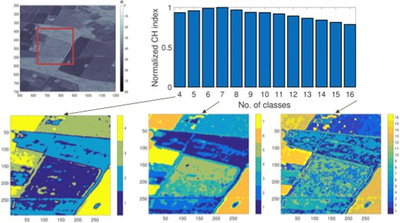
The PolBaRi algorithm exploits the polar decomposition S = UH of the scattering matrix, where the Hermitian factor H is rotation-invariant. Classification uses Riemannian k-means++ with the AIRM metric on the manifold of positive definite Hermitian matrices. Validated on RAMSES (X-band) and EMISAR Foulum (C-band) datasets, achieving 97% accuracy while preserving polarimetric texture. Riemannian extensions of Davies–Bouldin, Krzanowski–Lai, and Silhouette indices enable fully data-driven class number selection (Vasile & Congedo, IEEE IGARSS 2025).
PolSAR — Real Representation Scattering Matrix (RRSM)
For bistatic SAR, our RRSM formulation converts the complex consimilarity problem to a real eigenvalue decomposition. Eigenvalues appear in ±pairs: real for reciprocal targets, complex conjugate for significant asymmetry. Validated on Full-Wave simulations (C-band, 5.405 GHz). Directly applicable to upcoming missions: ESA Harmony, LuTan-1, DLR HRWS.
Wind Turbine Noise Estimation — Deep Learning
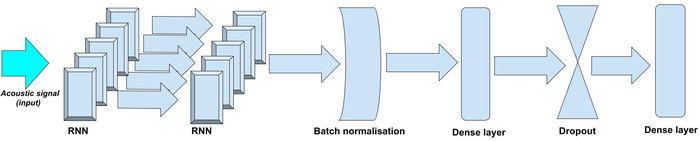
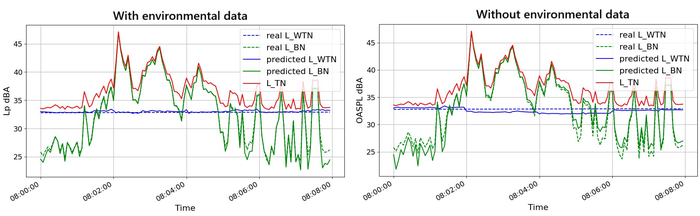
In A. Rkhiss's CIFRE thesis (ENGIE Green / CSTB), LSTM networks with Huber loss and constrained activation estimate wind turbine noise LWTN from total noise LTN without stopping the machines. MAE of 0.26 dB(A) with environmental data (wind speed + electrical production), vs. 0.72 dB(A) with acoustic data alone.
Underwater Acoustic Monitoring — Fish Counting (ACOUEAU)
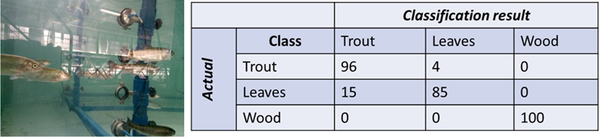
The FEDER ACOUEAU project (2017–2021) prototyped an IoT ultrasound fish counter (300–600 kHz, bistatic). Detection models fish passages as rare events with a Gamma-distribution confidence interval. Classification uses deconvolution + Hilbert transform + matched filtering. Deployed at Breil-sur-Roya: >95% trout detection across 5 target classes.
Glacier Monitoring by SAR Remote Sensing
Combining D-InSAR and amplitude correlation on instrumented glaciers (Mont-Blanc massif), we quantified velocities up to 1.7 m/day on the Bossons glacier and revealed seasonal dynamics from space. TanDEM-X analysis quantified radar penetration bias in dry snow (4–6 m in X-band above 3500 m). Sentinel-1 (6-day revisit) enabled continuous systematic monitoring.
Sponsored Projects & Industrial Contracts
Industrial Contracts
Research Projects


Professional Service
Editorial Activity


- Senior member IEEE · Member IEEE GRSS
- Associate Editor – IEEE Trans. Geoscience and Remote Sensing since 2022 (~20 papers/month)
- Editorial Board – AI section, MDPI Remote Sensing since 2020
- IEEE reviewing: TGRS, TAES, GRSL, JSTARS, TIP, JSTSP
- Reviewing: AMS MathSciNet, IET, Elsevier, EURASIP JASP, OSA, ISPRS JPRS, Traitement du Signal, Télédétection
Conference Service

- IEEE IGARSS TPC & reviewer (2008–2026) · GRETSI reviewer (2022, 2023, 2025)
- IGARSS 2025 & 2026: 3 sessions chaired + Session Organizer "SAR Tomography" & "Subsurface Remote Sensing"
- Co-chair IGARSS (2010, 2020, 2023) · Co-chair EUSIPCO (2014)
- Chair/Co-chair MTS/IEEE OCEANS (2015–2018)
- TPC: CoSeRa (2015–2020), COMM (2010, 2012, 2014), ISSPIT, ICA, APACE, CENCON, IEACon, PES APPEEC
Workshop Organization
- École de Physique des Houches spring school (2011)
- Workshop Analyse multivariée des images radar – GIPSA-lab (2013)
- Non-Stationary Signal and Image Processing – COMM 2014, Bucharest
Grant Evaluation


- Romanian CNCS: evaluator/rapporteur – PCE-2012, TE-2012, PCCA-2013, PED-2016, PED-2019, PED-2021, PED-2023 (10 proj., 2024), PED-2024 & PCB-RO-MD-2024 (13 proj., 2025) · ICT panel 2022 & 2025
- French ANR: ASTRID (2015), AAPG2021 · German DFG (2020) · Croatian Science Found. (2019)
- ANRT CIFRE (2020) · UGA IRGA (2021) · OSU THETA (2021) · Reims EXEBIO (2024) · Slovak SRDA (2025)
- 1 jury de thèse at Univ. de Limoges (examiner, 2020)
Institutional Service

- Co-Head of PICSA team since 2026 · Head of SigmaPhy (2020–2025)
- Elected full member (C/EC) of GIPSA-lab Laboratory Council (2020–2026)
- GIPSA-lab representative for GdR IASIS since 2018
- Scientific responsible of Mont Blanc technical platform since 2021
- Member COMDIR/CDU at LabEx OSUG since 2020 · SIG commission since 2011
- Eco-responsibility referent for SigmaPhy at LabEx OSUG since 2025
- GIPSA-lab COMM service commission (2019–2023)
- Comité de sélection MCF CentraleSupélec SONDRA (2015, 2016)
- Member URC: SWL F-21161
Plenaries & Invited Talks


Links
GIPSA-lab
PICSA / SigmaPhy team

HAL CV
Publications

IEEE Xplore
Author profile

IEEE GRSS – TGRS
Associate Editor

MDPI Remote Sensing
Editorial Board – AI

Google Scholar
Citation profile

Web of Science
F-5176-2011

Scopus
35424974600

BrainMap.ro
Romanian diaspora

Hebbian Hub
ML & AI
Contact
Gabriel Vasile
GIPSA-lab, CNRS / Grenoble INP
11 rue des Mathématiques, BP 46
F-38402 Grenoble Cedex, France
gabriel.vasile at grenoble-inp.fr